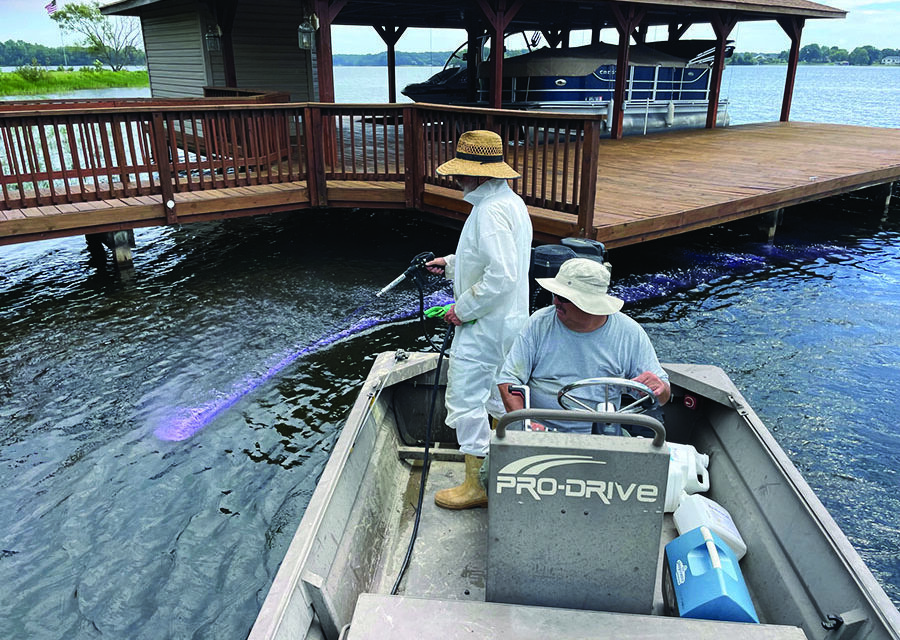
At its regular meeting on January 22nd, the Lake Anna Advisory Committee (LAAC) officially launched its comprehensive 2026 Hydrilla Treatment Plan for the public side of the lake.
The announcement marks a definitive shift in how the lake’s invasive weed populations will be handled, moving the community toward a highly integrated, data-driven and technologically advanced management approach.
The 2026 strategy was developed in strict accordance with the overarching Protocol for Hydrilla Management and Control at Lake Anna, Virginia. By aligning with this established framework—both documents of which are publicly available on the surrounding county websites—LAAC is signaling a commitment to transparency and scientific rigor.
Recognizing that invasive hydrilla presents a systemic, lake-wide challenge that cannot be solved by isolated neighborhoods acting alone, LAAC leadership announced key operational changes. These shifts are carefully designed to protect the fragile ecological health of the watershed while ensuring the lake remains recreationally navigable for residents and visitors alike.
At the core of the 2026 plan is a vital distinction: the goal is to control and manage hydrilla, not to eradicate it completely.
LAAC leadership explicitly emphasized that total eradication is not only cost-prohibitive, but it would actually harm the lake. Aquatic vegetation, even invasive species like hydrilla, provides vital ecological services when kept at manageable, moderate levels.
A completely barren lake bottom would severely disrupt the local ecosystem. Hydrilla acts as a massive physical biological filter, trapping suspended sediments, silt, and particles as water flows through it, which improves water clarity. It also provides complex structural habitat and cover for juvenile fish and macroinvertebrates.
Most importantly, hydrilla absorbs dissolved nutrients from the water column. By pulling excess phosphorus out of the water to build its own leafy biomass, hydrilla actively starves cyanobacteria of the primary fuel source that causes dangerous Harmful Algal Blooms (HABs). The 2026 plan seeks to balance this scale: keeping enough hydrilla to filter the water and absorb phosphorus, but reducing the density so it does not choke waterways or create safety hazards for boaters and swimmers.
The 2026 treatment plan introduces a fully integrated, reservoir-wide strategy that prioritizes safe navigation and is heavily driven by longitudinal trend analysis. Rather than simply reacting to where the weeds are worst in a given month, LAAC is continuously tracking the same environmental data across the lake over extended periods. This research method allows the committee to identify clear historical patterns, accurately measure what interventions are working, and adapt future strategies based on proven, scientific results.
To achieve this level of precise and effective management, LAAC is upgrading its physical tools. The committee is currently awaiting formal approval from Dominion Energy’s Reservoir and Environmental Management Division to integrate two highly regarded, EPA-approved herbicides from the SePRO Corporation into the lake’s sanctioned toolbox.
• ProcellaCOR is a highly selective herbicide that provides systemic control of hydrilla with a dramatically reduced active ingredient load. It degrades rapidly in the water column, mitigating the weed while minimizing the impact on native, beneficial aquatic flora.
• SonarONE is an advanced, pelletized delivery system offering sustained, broad-spectrum control. The pellets ensure that optimal herbicide concentrations are maintained precisely in the targeted treatment zones without overwhelming or unnecessarily treating the broader water column.
The physical execution of the 2026 Hydrilla Treatment Plan utilizes a hybrid approach, combining biological controls (sterile carp) with precise chemical applications across three counties.
Because triploid grass carp are sterile and eventually age out or die off, their populations must be routinely restocked to remain a viable biological control. LAAC will replenish carp in three key areas previously treated with this method:
• Louisa/Orange County: The Upper North Anna River near the reservoir inflow.
• Louisa County: Mitchell Creek (at the reservoir inflow) and Freshwater Creek (in the flats area near the inflow).
The plan also authorizes precise herbicide treatments in three specific reservoir zones, heavily utilizing innovative cost-sharing models:
• Lake Anna Plaza (Louisa County): A public-private partnership between LAAC and local homeowners to treat approximately five acres of severe hydrilla and Southern Naiad infestation. Costs for this treatment are being split between LAAC and the homeowners.
• Upper North Anna River (Louisa County): Another cost-sharing experimental treatment covering approximately 1.25 acres in the upper regions of the river.
• Spotsylvania County Subdivisions: LAAC will fully fund and treat approximately 42 acres of shoreline spanning the Duke’s Plantation, Rockland Creek Estates, Johnson’s Point, and Duke’s Creek subdivisions.
In addition to the publicly funded areas, LAAC approved 13 localized treatments to be funded entirely through private sources (such as individual HOAs). To maintain the integrity of the integrated reservoir plan, all private treatments must be executed by the same master contractor selected by LAAC and all private chemical applications are legally bound to adhere to the strict environmental requirements laid out in the Virginia General Permit.
The privately funded entities will work directly with the approved contractor to issue purchase orders and establish payment terms. Meanwhile, LAAC will maintain strict oversight, actively monitoring and tracking all private hydrilla treatments conducted within the reservoir to ensure they align with the lake›s broader ecological goals.
For residents residing on the private side of the lake, known legally as the Waste Heat Treatment Facility (WHTF), the jurisdictional rules remain different. Dominion Energy is solely responsible for the management and funding of hydrilla mitigation within the WHTF.
LAAC will continue to conduct comprehensive hydrilla surveys on the WHTF and will provide Dominion Energy with all resulting data to assist in their management efforts.
“I’m pleased with the way we have updated the Hydrilla Management Plan working with residents on the public side of the lake and with stakeholders like Dominion Energy and the Virginia Department of Wildlife Resources,” noted Cuckoo District Louisa County Supervisor and LAAC Chairman Christopher C. McCotter. “I am also eager to hear Dominion Energy’s plan for the WHTF this season as I know they are putting a lot of thought into how best to address resident concerns and maintaining an ecological balance in that part of the lake.”