
Many relatively new Lake Anna residents are experiencing a new low in the water level this year. As of November 30, the water level at Lake Anna was holding at 148.2 feet. Full pool is 150 feet. While this does make it difficult to use some launch ramps and some docks do not have enough water under them for boat lifts to function the water has been lower.
In 2001 the water level in the lake dropped to an historic low of 146 feet after three years of less than average rainfall. Many docks were out of the water. Small shrubs and grasses grew on the exposed lake shore. When the water returned to full pool the newly inundated shallows teemed with aquatic life.
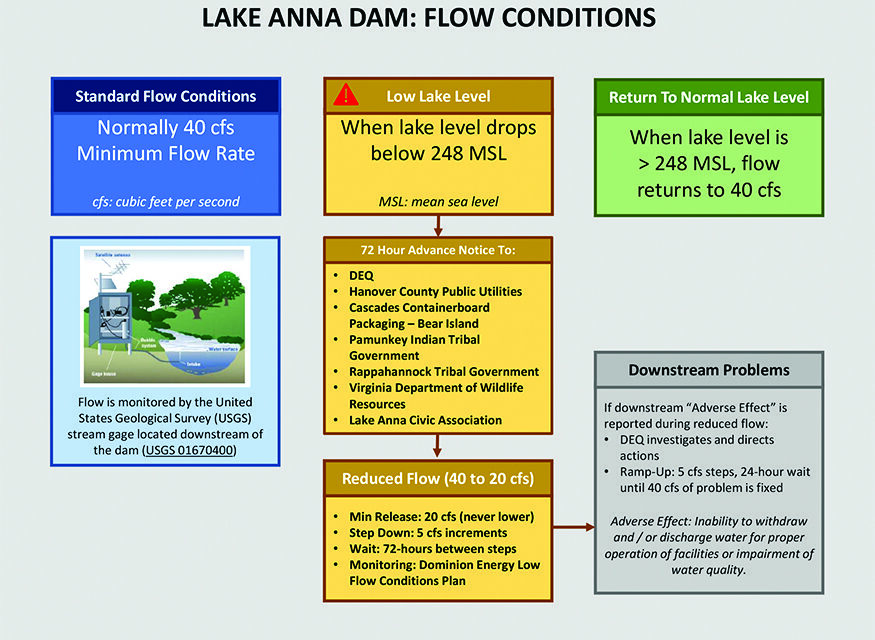
If the water level in the lake drops below 148 feet, Dominion Energy is permitted by the Virginia Department of Environmental Quality to reduce flow through the North Anna dam. The dam operator can reduce the flow from 40 cubic feet per second down to 20 cfs in five cubic feet per second increments with 72 hours between each. The mandated minimum dam release is 20 cfs.
The North Anna Power Station uses water from Lake Anna to condense steam back to water inside the station. The water is returned to the lake slightly warmer than when it was taken. The discharged water cools in a series of private cooling lagoons, known as the Waste Heat Treatment Facility (WHTF).
When North Anna is in full operation, approximately 2,000,000 gallons of water pass through the station per minute. As the discharge water flows to lagoons two and three, it gradually cools, and is eventually returned to the main lake at the Dike 3 discharge.
Lake Anna was developed to provide cooling water for North Anna and is 17 miles long, 1 1/2 miles wide, and offers 200 miles of shoreline.
Boaters will need to use caution when running flats, points and humps that are otherwise considered navigable during normal water levels. Extra standoff space will be needed when boating around marked hazards.
Part of what contributed to the rapid lowering of the lake level this summer were high temperatures in July/early August and scant rainfall after June (.9 inches in August, 1.93 inches in September, 1.39 inches in October and 1.1 in November. Year to date the area has received 33.39 inches of rainfall versus a 40.89-inch YTD average.